Fame


Been thinking about fame, actually the concept of “fame.”

IMG_7897I’ve never read what others have written about fame, think about it. Have philosophers delved into it?  If those “old dead white guys” have, it is certainly not with all the nuances that today’s technological culture brings with it.  And brings to media, communications and the creation of

FAME.   I define it as the public’s recognition of one’s achievement(s) in the public forums. So historically speaking that makes Edison, Elvis Presley, Michaelangelo, Alfred Hitchcock, Louis XVI — all famous, to name just a few. Some were even recognized in their own time! I say this pointedly as too often it takes death to confer the mantle of worth and fame, especially on artists. This is a reflection of the doctrine of scarcity: now that the maker can no longer make her products they become more desireable, of greater worth.   But I digress.

There seems to be a taint to fame these days;  a cheapening.  It has lost some of its dignity, its luster. Rock stars and movie celebrities are famous. Politicians can become famous, especially when involved in a sex or money scandal. Ah! But I am wrong. The last is not fame. Remember the concept of infamy? When one becomes famous for doing something nefarious or scandalous or both? Then one is infamous, not famous.

It seems to me the importance of that distinction has been a bit lost of late.

What is the point of fame, or being perceived as famous? Fame exists in a broad spectrum, doesn’t it? There is the local Little League star, the winner of the Pumpkin Festival, and the State’s beauty queen.  We go to rock concerts, symphonies and museums to see well-known — “famous”– artists.  We can be passionate about and cheer national sports figures and war heroes. We have scientific geniuses and technology gurus who become our heroes and heroines.  Well known, famous for their contributions to society.

Then there are those who seek fame for just fame’s sake.  I don’t get this; fame junkies must be really whacked, just very insecure; have hungry egos.  Why need the attention and admiration of masses of strangers?  There’s no nutrition there, it’s pure junk food for the soul.

On the very very other hand, there are those who have overcome  difficult and obstinate obstacles in their striving to become/achieve/defend.  These ones often are not thinking about becoming famous or seeking any recognition, but simply determined to look at and solve the problems in front of them, come hell or high water, so to speak.  They gain public admiration and  fame, sometimes to their own surprise.  Think Helen Keller, the Grimke sisters, Stephen Hawking.

I think the best thing about the notion of “fame” is that it confers a sense that a contribution to society  has been made that inspires others; a road map… the individual (or group) responsible for the achievement is a role model for the rest of us.  An inspiration.

So, at its most positive, fame’s purpose can be said to be to promote inspiration.

Other than that…fame is just a form of Viagra for the Ego.          photo by Lisa Lindahl

And that is certainly not of True Beauty.
 

Whoopsies of this Life

photo by Lisa Lindahl

photo by Lisa LindahlSo a lot has been going on.

Life has a way of creating cycles:  months of humdrum and habits — sometimes soothing, sometimes boring.   And then sudden huge waves of change, happenings, things you can’t say no to.  Some things you have no opportunity to say no to; death is one of those.

So I’ve been juggling a few things; traveling a great deal, across the country, up the coast and down the coast and back again…and again.

One of the changes occurring during this time is switching where this blog lives, it’s host or whatever.   A simple task you would think.  Not so.  The process, much more tedious and long than it should have been, is the reason I haven’t been able to post recently and the reason my more recent posts seem to have disappeared!  Whoopsie!

Ah, I love technology!   You can find the post “Spring” on our FB page “The Way of Beauty”.

And speaking of whoops!, a reader pointed out to me that nowhere on this blog page do I make it clear that what I am writing about is TRUE BEAUTY.   That is a major whoops.  The whole reason for this blog is to make a pitch about the importance of ditching what passes for “beauty” these days and reclaiming TRUE BEAUTY!   (See the post “A Manifesto for True Beauty” waaaay back in the beginning).  Well, and to make way for my book about it, coming soon…

So, whoops, I gotta change the masthead, or whatever its called here, to make it clear what I (mostly) go on about:  deep, true Beauty and its importance in our global harmony.

So, change is good.  We must perceive it as such as it is, after all, the only constant!

Ah, yeah…a lot of stuff going on!  And whoopsies are only to be expected…       photo by Lisa Z. Lindahl

Havingness

photo by lisa z lindahlHere’s a term I picked up along the way and made my own:  Havingness.      I define it as the ability to have; to take ownership — easily and comfortably.

While one can be in possession of a thing, experience an emotion, or hold a particular attitude — indeed “have” these — this is not quite the same as what I mean when referring to “havingness.”  Havingness is that state of being in a person which allows him/herself to graciously take ownership of whatever comes, but with a specific connotation of plentitude.

Havingness is a state of being.  It is that state which embraces  life, experiences, people and is infused with an expectation of abundance.  (Note:  expectation, not entitlement!)

And let me make something very clear:  conspicuous consumption — visible bragging through the excessive and obvious acquisition of things — is not a form of havingness, or what I mean in any way, shape or form.  I believe the behavior known as conspicuous consumption is an outcropping of insecurity and a misunderstanding or ignorance of the usefulness of material wealth.  Frankly, its manifestation is distasteful to me on several levels.  In fact, I’d guess that those who engage in conspicuous consumption are actually not compensating for their lack of having stuff, but for their lack of having a sense of havingness.

I hope this doesn’t all sound like confusing gobbledy-gook.

Generousity is born of havingness.  A child who has one apple and cuts it in two to give half to an apple-less friend has a sense of havingness.  The child who has a whole basket of fruit and will give photo by lisa z lindahlnone away has no havingness.  Another way to articulate this is to say that the first child unthinkingly assumes abundance in her life — probably more apples in the future — while the second child assumes a future of scarcity.  She must hoard her fruit for the feared apple-less future.
And so what?  Why does this matter?  Why think about it?

One reason is that these days many think about living “responsibly.”  Recently I heard about a trend towards “Minimalism” — living with less, or even the least possible.  Is this a good thing?  Is it somehow more noble?  As well as being a uniquely First World question, I think there is a question of age appropriateness in that question somewhere.  Different cycles in life have different needs and levels of need.  If you are 20 and childless, minimalism may be a good thing.  Or at 70 with an empty nest and a desire for the end of  never-ending house maintenance, minimalism may be a great solution.   But these days a family with children, aging parents and/or/as well as hectic work schedules can make the minimalistic life-style seem like an absurdist joke.  “Subjective Minimalism” perhaps can become a thing.  I dunno, maybe it already is.

All of which brings me back to havingness.  Those who are without an ability to have, when having comes their way,  are fearfully over planning, over consuming and too often sabotaging life’s synchronicities and blessings.  It is my experience that a true sense of havingness will direct one to  that comfortable and appropriate level of not just materialism, but also of community, convenience, spiritual involvement and a general sense of balance in one’s life.

photo by lisa z lindahl


Flashback – Artist vs. Businesswoman

I came across the following essay I wrote many many years ago, prior to selling my business.  Now that I am a practicing artist again, come full circle, I thought I’d share it here.

From a journal entry, 1990:

    An old class mate I haven’t seen in about 13 years called me the other day to ask for a charitable contribution. Although I get such calls rather frequently, what made this one different was that towards the end she asked, referencing our school experience together, if I was still writing poetry. It took me aback — and back. Here was a person whose last experience of me was that of artist and  writer. I found myself fumbling over my answer.

    Twelve years ago when I broke up my stained glass studio, folded up my easel and put away my oil paints my friends (mostly artists) asked with incredulity, “How can you go from being an artist to a business person?!”

    At the time, I found starting a business extremely challenging and exciting; a daily learning experience that stretched me enormously. It was, in those early days, very definitely a creative process.

    In the course of my studies at the University of Vermont, I had taken a course that explored the nature of the creative process. The text was a compilation of writings on the subject by recognized creative thinkers: Albert Einstein, Vincent Van Gogh, Friedreich Nietzsche and Carl Jung to name a few.   Each one, quite separately, recounted similar experiences of the process, drew similar conclusions. To wit, that it begins with vision and boils down to problem solving. Said problem-solving incorporating looking at all the different ways there are to solve a problem, and then to apply the best one.  

In thinking of this in relation to starting a business, I came up with the following:

Have a vision, make a decision re its scope, identify the essential elements needed and then go about organizing the elements that will make manifest your vision. Confront all the obstacles/problems that present themselves as you go along, but do not jump on the first solution that presents itself. Ask yourself, “is this the best solution? What are the long-term implications for my vision?”

    In painting, composition, light, color, their relationships, are all elements of a puzzle to be “solved” or put together — oft-times with several different workable solutions that the artist tries out. A delightful puzzle that can go together in an infinite amount of combinations, limited only be the individual’s imagination, and surely stamped with it.

   And so, during the start-up phase of my business, my career change didn’t seem all that radical. I was simply applying my creative process to a different medium: commerce. Now it was product, resources, people, places, information and their relationships that have to be sussed out.  But often, of an evening, I would pick up a pen and write away. Some weekends I would paint. But slowly those urges diminished. Finally, I am left only with a reputation in the office of being an irrepressible doodler, covering pages and pages of yellow pads and meeting agendas with what’s left of the “artistic” manifestation of my creative abilities.

    When I heard my ex-classmate’s question, I found I felt guilty, a bit ashamed! She, after all, had managed to integrate her art into her mode of making a living. Had I?

    After we hung up, I sat at my desk reflecting. What had happened to my creative process? It had all been channeled into the endeavor of maintaining and running a business. I wrote down the thoughts above.  And it occurred to me that the product is rather abstract: a successful business.

    These days there are no creative juices left in me by the time I get home at night.   I feel disappointed in myself. If I try and review my day and see where those juices went, I see the puzzle of a business: sales strategies, budget crunching, people management, product extensions.

    Really, am I still an artist? Working in the medium of money, creating business? Has the canvas become industry, the paints our products and the brushes our employees? The score card lies not with the critics’ aesthetic acclaim, but in profit and loss statements.

    The real question for me is one of worthiness. We live in a culture that lionizes the pursuit of the dollar and dismisses the importance of art. Somewhere along the line artists got characterized as being rather self-indulgent, eccentric and irresponsible; while the words most often associated with the businessman or woman are more along the lines of “serious,” “contributor,” “hard-working,” and, of course, “responsible.”    

    And what is all this reflection leading to? For me, the task is to discover the truth beyond the stereotypes. To examine the daily applications of my creative energy and judge, for myself, their “worthiness.”

~*~       ~*~      ~*~

So here I am, all these years later….  That business and my part in it are now history, literally, preserved in the Smithsonian Archives.  I have come full circle and am writing and making visual art again.

And here is my 2016 answer to the 1990 question I posed all those years ago re worthiness:

It is all worthy.  Every bit.  Every struggle, painful partnership, different modality, confusing medium, and foreign-to-me industry (sporting goods!?).  Every lousy painting, dry spell, failed product and awkward phrase.  Every accolade and award.

Because it is spirit, our individual spirit incarnate encountering the Is-ness and having experiences of creation — evolving our Is-ness, as we all must.  As we all must, in the infinite ways that are within us to do so.

ABSOLUTELY GLORIOUS!


A Gallery of Seeing, Musing…

photo by Lisa Z Lindahl


It’s camellia time in the Low country!

photo by lisa z lindahl photo by Lisa Z Lindahl


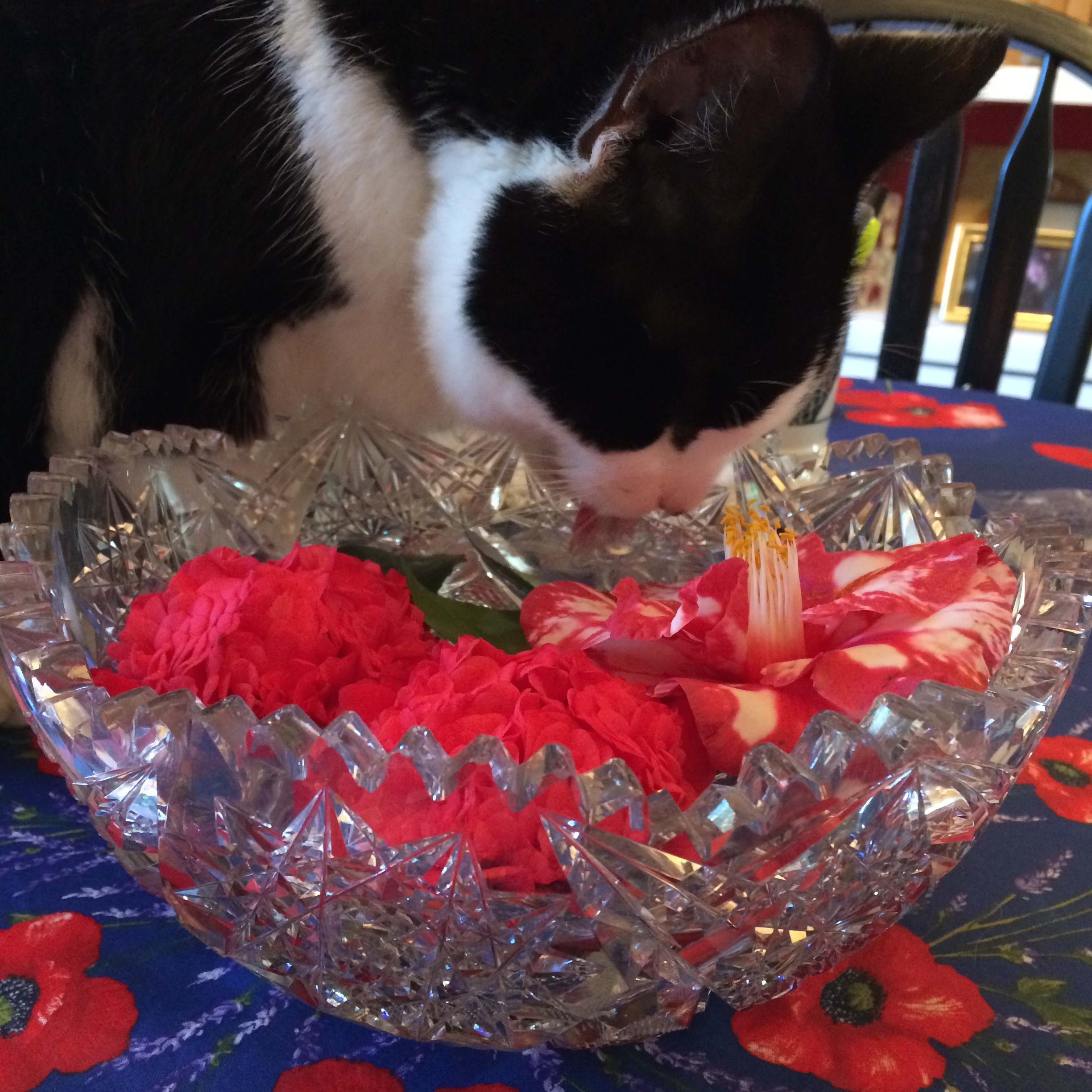
Even the cat enjoys the camellias…

photo by Lisa Z Lindahl


I still bring other flowers into the house.  A habitual indulgence:

Photo by Lisa Z Lindahl


Hmm…Fire and Air…any wonder they imitate one another?

IMG_8458 IMG_8712


And now my other cat reminds me it’s time to read the important part of the Sunday paper…

IMG_8797


Have a lovely day!

A Fantasy

Farmers

Teachers

Mothers

What if these were the most revered, the most respected and highly compensated jobs and roles in our society?

What/who are they now?

Football players

Actors

Corporate CEOs

In the interests of being totally transparent, I did little* research about the above other than reading the news and observing what we do for entertainment.  And

I saw a bumpersticker the other day that read:  No Farms, No Food

and that got me thinking…uh… “Right!”, duh!  So:

Nourish the body — farmers

Nourish the mind — teachers

Create & nourish the human — mothers

Imagine with the above scenario of revered citizens:  the Mother who grows citrus trees that repeatedly  bear luscious and bountiful fruit and who then teaches her successful methods to all who are interested to learn.   Year after year…      Songs are written and sung about her.  She is a heroine.

No one has heard of football.  C, E, and O are just letters in an alphabet.  And most everyone has fun being the actors in a play when not watching one!  Then they go back to teaching, or studying to be a better farmer or mother.

~ ~ ~

Oh, I know it is a very simplistic fantasy!  Let me have it for a few moments.

*the research I did do revealed that in actuality doctors, specifically anesthesiologists, are the highest paid occupation in the U.S.  But this was calculated using hourly wage-earning.  I couldn’t find any data on how much Leonard DiCaprio is paid by the hour.  And it would really take a lot of sting and humor out of my essay if I were to mess it up with an actuarial truth.


Holiday beauty in the Lowcountry

Visions of sugarplums

~flowers

dance in my head

~before my  eyes

during this winter holiday:

photo by Lisa Z. Lindahl
My Christmas Geranium

photo by lisa z lindahl

photo by Lisa Z. Lindahl
Nandina, a Chinese evergreen in the yard


photo by Lisa Z. Lindahl
Camellias

And there are some green spirits and holiday fairies around as well…    

photo by Lisa Z Lindahl
tree fairies at play


photo by Lisa Z Lindahl


photo by Lisa Z Lindahl
An Elemental residing out back


One Woman’s Evolving Epilepsy Cycles


from zaldenjace - hubpagesLife cycles through different stages.  In Feminine Wisdom we know about the main three that influence the developmental cycles of women:  Virgin (or maiden), Mother (self-explanatory), and Crone — or as I like to think of the last — Wise Woman.

I am at the Wise Woman stage.  I’ve noticed and experienced many sub-cycles within the larger ones.  All of us have.  But one sub-cycle that is rarely talked about is those cycles that a woman* with epilepsy can go through — or more accurately, the evolving nature of the disease and how it can impact us.  It is not static.  (*I’d include men, but I have no current details about their gender-specific experiences).

And I’m betting that I have not been alone in experiencing many of these cycles.  I  hope that any others with epilepsy who  find my observations familiar or, conversely, disagree with some of my comments will respond with their own, and add their own experiences in the “Leave a Comment” section.  For those readers without epilepsy, I hope this is educational — maybe even enlightening.

When I was a maiden I had absence seizures, diagnosed at age 4. Back then they were called “petite mal” seizures.  The doctor let my parents know that when I reached puberty the epilepsy could either disappear or escalate.  There was no way to know for sure.  So we all had hope and besides being constantly nagged “did you take your pills!?” epilepsy didn’t have a huge impact on my childhood, at least from my perspective.  This was the first cycle of my epilepsy experience.  Really I was blessed, as I knew nothing of living without seizures.

My first grand mal (meaning a full- out convulsion) at age 12 took place rather dramatically in my 6th grade classroom.  In an aura I suppose, I remember the boy I had a crush on laughing as I went down.  It could have been the ruin of my budding social self.  But I consciously chose to go back in the classroom a few days later with the attitude of holding the ridiculers in disdain — to consider those who would mock me as insensitive jerks.  I went back with my head held high.  It seemed to work; I wasn’t bullied or shunned.  Because I went forward as if all was fine, so did my classmates. So began the second season of my evolving relationship with epilepsy.

original art (c) E.Z. LindahlI was lucky.  I only had grand mal seizures infrequently, usually around my menses as I came, in time,  to notice.  The doctors back then were adamant that there was no correlation.  (Now they know differently).  As a young adult my seizure pattern became sort of reliable.  I was able to manage my seizures enough to have a life.  I went to college, got a job, was fired from that job because of an epilepsy-related issue (I didn’t drive), and married.  I became self-employed.

But as my motherhood years rolled around and became fewer, I realized I was afraid to have a child. Being responsible for myself felt enough — to be responsible for an infant as well made me anxious. What would happen if I had a seizure while holding my baby?  I decided that I’d have children if I met & married a supportive man who would be an active parent.  I never did.  I married twice, but both men were not interested in having children.  During the better part of those years I was busy running a business and chose not to notice as my time for mothering rolled by. Besides, the business was my baby!

After selling that business I spent 9 years volunteering with an epilepsy advocacy organization.  Learning a great deal there, I came to do a fair amount of epilepsy education.  I traveled around the country and spoke about epilepsy issues and successful seizure management from a patient’s point of view.  Often I spoke of the gender differences, having worked on that specific topic.

This last was an empowering cycle.  Though I switched medications a few times, had some bad patches, etc., I had made that part of me — the person with epilepsy — public, found I had a role to play and could be helpful in and for that community.  It was very fulfilling.

Here in the Wise Woman years I had assumed  I’d be okay — less hormone interaction, on the anti-epileptic drug that gave the most control with the least annoying side effects (finally!).  I’d envisioned being entrenched in a supportive community, with my second husband by my side.  Not to be.

Frankly, now I am a bit frightened.  My seizure type and pattern have  changed.  Or seemingly so.   The supportive husband has fled.  My siblings all live far away…and I don’t yet know how to manage this new set of circumstances.

And I must learn to in order to maiphoto by Lisa Z Lindahlntain my independence and well-being.

Meanwhile, the docs are having difficulty finding appropriate meds.  I was on one that I liked a great deal — no breakthrough seizures and few noticeable side effects.  Or so I thought — seemed my dream medication caused some organ stress, and I had to get off it.

For those of you who know about epilepsy you know how difficult and risky switching your meds can be.  I’ve come to know that I have to set aside a month of  living my usual life to responsibly switch.  It involves:  the tapering off period while slowly adding in the new drug —  the watching for  serious or simply difficult side effects.  The nausea, dizziness, cognitive fuzziness that can set in while my body readjusts.  The seizures that can occur.

I dislike asking for help.  Gawd forbid I should inconvenience anyone!  (I’m trying to work on where that came from).   Most people do not understand what is going on in a medication change,  the level of risk and how vulnerable I feel.  It’s my issue and problem after all.  And the epilepsy cycle that is going on now has me quite up a creek.  Who knew I would be at this point now?  Not me.

And I wonder:  is this the last cycle in my epilepsy evolution, or are more to come?  I gotta stay tuned, don’t I?

Dang — no rest for the weary!  original artwork by Eugenie Lindahl


Holidays, Holy Days, Holi-Daze

I’ve never liked November.  I don’t exactly know why, especially since there are so many celebrations in my family in November as well as, of course, Thanksgiving.  And I’ve always enjoyed Thanksgiving, so why do I dread November?photo by Lisa Z Lindahl

Perhaps it is the dreary weather so often encountered in the Northeast, where I grew up and lived for so many years.  Lack of sun, the gray and too-barren landscape, early snow storms conspire to undermine my personal practice of Beauty.  I can find that Beauty in November’s landscape — but I have to work harder at it, and that bothers me.

photo by Lisa Z Lindahl
Camillia sasanqua

It is easier here in the Southeast.  The camellias are blooming red, pink and white in my yard.  The Live Oaks wear their stoles of Spanish Moss which sways elegantly in the November breezes.  There is plenty of sunlight.  I need only to look out to encounter True Beauty in this place’s November.

Spanish moss hanging from Live Oak in the evening
Spanish moss hanging from a Live Oak in the southern evening


My November discomfort may be related to the holidays — or what I call the holi-daze.  Over the course of my life I have spent too many of them alone, and that has been difficult.  When I recall all the past holidays that were filled with family and loved ones I too often compare and contrast with the “alone” holiday experiences.

But as I have written elsewhere, comparing and contrasting can be an unproductive trap.  The action may eviscerate any truth of the Beauty at hand, here in the present.

And here I am, looking at my dread, figuring it out, moving away from it and beyond — I hope!  And remembering that I am so grateful to be living in this country, in these times, where we have so much freedom to be.  To be.

So:

HAPPY DAY, HAPPY THANKSGIVING — GIVE THANKS! 

Flashback II


Another essay from my archives, this was written in 1992…  So precocious!  I was only 3 years old then…

Vestigal Senses?

Kirlian photography has shown that we have electrical current running out thekirlianfingers-1 tips of our fingers and toes. On the market now there are even little toys that can be made to make noise by placing your fingertips on tiny little terminals placed there for that purpose.

This got me to thinking. What if, once, we humans had far greater power and greater control over it? What if the mysteries of how the pyramids were built, or the Mayan and Incan temples were built could be explained by saying that man was simply capable of moving great objects by pointing his hand, directing his inner energies and moving the object?

We know that ancient civilizations had knowledge and wisdom that we, in our narrow-minded obstinant adherence to “scientific reasoning” cannot account for or give credence to. How did the Mayans and Incans have such a sophisticated understanding of astronomy? we ask in wonder. How did the ancient Egyptians know enough of engineering to build the pyramids?

imagesWhat if, what if ancient mankind had a superior understanding and control of NATURAL energies? We, who are so dependent on the clumsy MECHANICAL way of doing things…what if flying through the air was not dependent upon a huge metal and fire machine, but instead on one’s inner, disciplined energies?

I think of the old tales of wizards and gods who could hurl a bolt of lighteneing from their hands, or see great distances, or know of impending events before they occured. And I wonder. I wonder if these were the last of humankind to lose their full powers. I wonder if we have evolved away and out of the knowledge of that power and are left only with its vestiges… a little trickle of electricity dribbling from our once-great and magical fingertips.

And then I get to thinking about the human brain. With all our science and reasoning it remains mysterious and unknown. The researchers tell us that we are only using about a tenth of our brains, as far as they can tell. And I think of all those neural pathways conducting electricity through our gray matter…and I wonder some more. Because I have epilepsy, I know–or have been told–that seizures are simply too much electricity coursing through the brain, making the current jump track out of the containing and directing pathway and short-circuiting the entire brain functions. Oh, really?

What if. What if people who experience convulsions are simply throw-backs to a time when we had more power, and the only deficiency of these modern day, unwitting wizards is that they have no idea how to channel that energy, use it, discipline it, direct it…and so it goes through a cycle of build-up/release, build-up/release, and so on.

The oracles of Delphi in ancient Greece were considered holy, wise and able to communicate with the gods because they had convulsions. It was in the Unknownconvulsive state that they were supposedly communicating with the gods. Later, in medeval times convulsing people were thought to be possessed by the devil. Either way, the taint of the supernatural and/or paranormal was on the individual who experienced the altered state of consciousness that we call a “seizure disorder.” And today, modern man’s response to this is to apply drugs to suppress the experience. It is what I call the “if you can’t understand or use it, make it go away.  Suppress it with drugs” method of coping. How much ancient knowledge or ability has been lost in this way?

Intuition, ESP, psychokinesis, prophecy, astral projection…the list is very long of things our modern science cannot explain and so belittles.

What if we were once a race of wizards, left now with only the faint dregs of our original powers and knowing?  We now have only our vestigial senses…