Flashback – Artist vs. Businesswoman

I came across the following essay I wrote many many years ago, prior to selling my business.  Now that I am a practicing artist again, come full circle, I thought I’d share it here.

From a journal entry, 1990:

    An old class mate I haven’t seen in about 13 years called me the other day to ask for a charitable contribution. Although I get such calls rather frequently, what made this one different was that towards the end she asked, referencing our school experience together, if I was still writing poetry. It took me aback — and back. Here was a person whose last experience of me was that of artist and  writer. I found myself fumbling over my answer.

    Twelve years ago when I broke up my stained glass studio, folded up my easel and put away my oil paints my friends (mostly artists) asked with incredulity, “How can you go from being an artist to a business person?!”

    At the time, I found starting a business extremely challenging and exciting; a daily learning experience that stretched me enormously. It was, in those early days, very definitely a creative process.

    In the course of my studies at the University of Vermont, I had taken a course that explored the nature of the creative process. The text was a compilation of writings on the subject by recognized creative thinkers: Albert Einstein, Vincent Van Gogh, Friedreich Nietzsche and Carl Jung to name a few.   Each one, quite separately, recounted similar experiences of the process, drew similar conclusions. To wit, that it begins with vision and boils down to problem solving. Said problem-solving incorporating looking at all the different ways there are to solve a problem, and then to apply the best one.  

In thinking of this in relation to starting a business, I came up with the following:

Have a vision, make a decision re its scope, identify the essential elements needed and then go about organizing the elements that will make manifest your vision. Confront all the obstacles/problems that present themselves as you go along, but do not jump on the first solution that presents itself. Ask yourself, “is this the best solution? What are the long-term implications for my vision?”

    In painting, composition, light, color, their relationships, are all elements of a puzzle to be “solved” or put together — oft-times with several different workable solutions that the artist tries out. A delightful puzzle that can go together in an infinite amount of combinations, limited only be the individual’s imagination, and surely stamped with it.

   And so, during the start-up phase of my business, my career change didn’t seem all that radical. I was simply applying my creative process to a different medium: commerce. Now it was product, resources, people, places, information and their relationships that have to be sussed out.  But often, of an evening, I would pick up a pen and write away. Some weekends I would paint. But slowly those urges diminished. Finally, I am left only with a reputation in the office of being an irrepressible doodler, covering pages and pages of yellow pads and meeting agendas with what’s left of the “artistic” manifestation of my creative abilities.

    When I heard my ex-classmate’s question, I found I felt guilty, a bit ashamed! She, after all, had managed to integrate her art into her mode of making a living. Had I?

    After we hung up, I sat at my desk reflecting. What had happened to my creative process? It had all been channeled into the endeavor of maintaining and running a business. I wrote down the thoughts above.  And it occurred to me that the product is rather abstract: a successful business.

    These days there are no creative juices left in me by the time I get home at night.   I feel disappointed in myself. If I try and review my day and see where those juices went, I see the puzzle of a business: sales strategies, budget crunching, people management, product extensions.

    Really, am I still an artist? Working in the medium of money, creating business? Has the canvas become industry, the paints our products and the brushes our employees? The score card lies not with the critics’ aesthetic acclaim, but in profit and loss statements.

    The real question for me is one of worthiness. We live in a culture that lionizes the pursuit of the dollar and dismisses the importance of art. Somewhere along the line artists got characterized as being rather self-indulgent, eccentric and irresponsible; while the words most often associated with the businessman or woman are more along the lines of “serious,” “contributor,” “hard-working,” and, of course, “responsible.”    

    And what is all this reflection leading to? For me, the task is to discover the truth beyond the stereotypes. To examine the daily applications of my creative energy and judge, for myself, their “worthiness.”

~*~       ~*~      ~*~

So here I am, all these years later….  That business and my part in it are now history, literally, preserved in the Smithsonian Archives.  I have come full circle and am writing and making visual art again.

And here is my 2016 answer to the 1990 question I posed all those years ago re worthiness:

It is all worthy.  Every bit.  Every struggle, painful partnership, different modality, confusing medium, and foreign-to-me industry (sporting goods!?).  Every lousy painting, dry spell, failed product and awkward phrase.  Every accolade and award.

Because it is spirit, our individual spirit incarnate encountering the Is-ness and having experiences of creation — evolving our Is-ness, as we all must.  As we all must, in the infinite ways that are within us to do so.

ABSOLUTELY GLORIOUS!


Self Compassion

photo by Lisa Z Lindahl

Is it possible to have compassion for oneself?

If we understand compassion as the ability to experience another’s pain, how would it be possible to have compassion for oneself?  Don’t we just, well, have our own pain and suffering?  How is the notion of compassion for ourselves relevant?

Somehow it is.  Somehow it must be so.  It may not seem logical, but if you’ve been reading this blog for a time you know that on the Way of Beauty, reason and logic  are often outranked by the alchemical and magical forces.

And alchemy is essential in healing.  It is the changing of the metaphorical lead into gold, illness into wellness.  How we approach, hold, and release our own suffering is key to the quality of our lives.  Need I remind any of us, there is no such thing as a life without some sort and degree of sufferiphoto by Lisa Z Lindahlng?

My goal for one recent year was “Be kind to yourself, Lisa!” What did I mean? I meant, in pop parlance, to give myself a break.  In Way of Beauty terms I meant to have compassion for myself.    Too often our harshest critic is ourselves:

Only got a B+ on that exam? Shame!

Just because you had surgery last month and have been doing PT three times a week is no excuse for being behind on the month’s sales’ stats! Get with it!

Isn’t that baby fat gone yet ?!  I brought the baby home two weeks ago!

The divorce was a year ago!  Stop talking about it!  Those 20 years are in the past!

You get the picture… too often our expectations of ourselves hold little compassion, no allowance for any suffering, any expression of the pain, for any margin of error, let alone honoring the authenticity of that suffering, the recognition of the need for a necessary and healing process of  grieving, hurting.

We hold our suffering at bay, not allowing it in, feeling it, allowing it to be real, true.  I might spin off here into the need and illusions of perfectionism, but that is for later. Now we are addressing being compassionate towards ourselves, understanding and forgiving of ourselves as we go forward doing the best that we can with the information and the tools at hand under the circumstances we have created for ourselves – with the helpful knowledge that nothing is static. Life and we are evolving.

Recognize your suffering: don’t let it rule you – either by assiduously ignoring it or by placing it on the throne and becoming its servant; wallowing is not healing either.  A quick aside:  Self-pity is not the same as self-compassion.  There is a world of difference — that’s why there are different words.  Pitying someone or yourself is not a constructive act.  In our times a connotation of contempt has grown around the action of pity/pitying someone that is absent in other words that seek to address describing feeling with others.

As a teen-ager I remember my mother admonishing my moody 14-ish self: “Stop feeling so sorry for yourself!”  My older sister would taunt:  “What’s with the pity party?”  So I was taught it was not only selfish and unattractive behavior, but also I learned that it got me no where:  it was unproductive. Hmmm.  How is it some adults have somehow missed that day at “How to Be A Grown Up” school?

But I digress.

Perhaps most importantly, endeavor not to disassociate from your pain. Ironically, through compassion for yourself you will learn that it is not an other,  that “bad back” or (from my repertoire:) “stupid seizure disorder”.  It is you, part of you. There is no “it” and “me.” When feeling compassion for yourself – feeling your own pain and suffering – speak of “we.”

“Oh dear, my broken heart, what must we do to get through to the other side of this!?”

HAPPY VALENTINE’S DAY TO US!


photo by Lisa Z Lindahl


The Metaphorical Road Trip*

photo by Lisa Z Lindahl
California Poppies

You are heading towards California.  You decide you want to go with someone else — company on the trip, share costs, more fun you think, ’cause you’ve gotten this far on your own and find yourself a bit lonely, a bit tired of doing everything yourself.

You find someone compatible.  The other person is on the brink of traveling also.  Aha! you think, road trip partner!  You talk; both of you are discussing all the places there are to see, experience.  You mention that yes, all those places — but your intention is to land, eventually, in California.  The other person nods, and then keeps talking.  You think Aha!  They want to go to California too!  Yay!

And you hook your stars to each other’s proverbial wagons and take off together.photo by Lisa Z Lindahl

You buy a vehicle together.  Work and earn money along the way; share gas and other costs. It is being a grand road trip.  You see all kinds of places, meet lots of people — some of whom become friends you stay in touch with even as you travel on.  Individually and together you both have some great experiences as well as a few scary ones.  Then, too, there are just the miles and miles of daily tarmac spinning by.

You are writing home often, and after awhile find yourself avoiding the topic of California in your emails.  So far the trip hasn’t gotten you much closer to that part of the world and when you have brung it up your companion just sort of grunts and doesn’t really respond.  You are getting worried.  You realize you haven’t really brought it up much at all lately.  And lately the direction the two of you have been traveling in has been more and more away from California.  How can that be?  When did that start?

So you bring it up again.  More directly.  “I thought we agreed we were going to California — the long sight-seeing way, yeah — but heading there nonetheless.  Right?”

“No,” your companion replies.  “I never agreed.  I’ve always been thinking about Alaska; I told you that.  You just were so full of California you didn’t hear me.  But when you stopped mentioning California I thought you’d come around to my way of thinking!  Right?”

Hoo Boy!  What a pickle!  All that time.  All those experiences together.  And all the time you were actually headed in very different directions.  How could you have misunderstood each other so?  But you did.  You did.  Your companion did.  And now what?

Set out on your own.  Again.

There are some set backs.  For one, you have no vehicle, your past cohort took it giving you some cash  for your half (less depreciation) — not enough for you to get back on the road in a motorized (read efficient, safe) fashion.  So you hunker down where you find yourself, take inventories: physical,  fiscal, mental and emotional and start making plans and taking actions to get going again.

Some time goes by as you gather the tools and some further knowledge you need in order to take off again on the road towards your (still) desired destination.  A few times you are offered rides, at least part of the way, by other people.  Some were genuine and well-meaning, but felt wrong.  One felt like a downright bait and switch scam, and you were soooo glad you spotted it ahead of time.  What a detour that might have become!  You chose your own time and way to set out.

But you find you are beginning to get tired of doing everything yourself again.  Plus you’ve noticed it doesn’t feel so good not having a particular person with whom  to share your experiences.  Someone who might have a different view/opinion/knowledge from your own, but would still be on your team.   Wouldn’t that be refreshing!  You start dreaming.  You imagine you’d like to have a partner on this trip, someone who shares your desire to go to California — and beyond!?

photo by Lisa Z Lindahl
California back road

Now, you hope, you’ll be clearer in choosing one — listen better.   Ah, well.  Sometime.   You forge forward.

And you do get yourself to California.  With great pleasure and anticipation you take a deep breath and contemplate your new world.  And as you settle in you consider looking for a partner to play with, work with and to co-create this — your next, California future with.

And you do…

*The above is a parable told by a Mother to her young teen-aged Daughter during their discussions about relationships, futures, etc.   What do you think?  Leave a comment!

A Gallery of Seeing, Musing…

photo by Lisa Z Lindahl


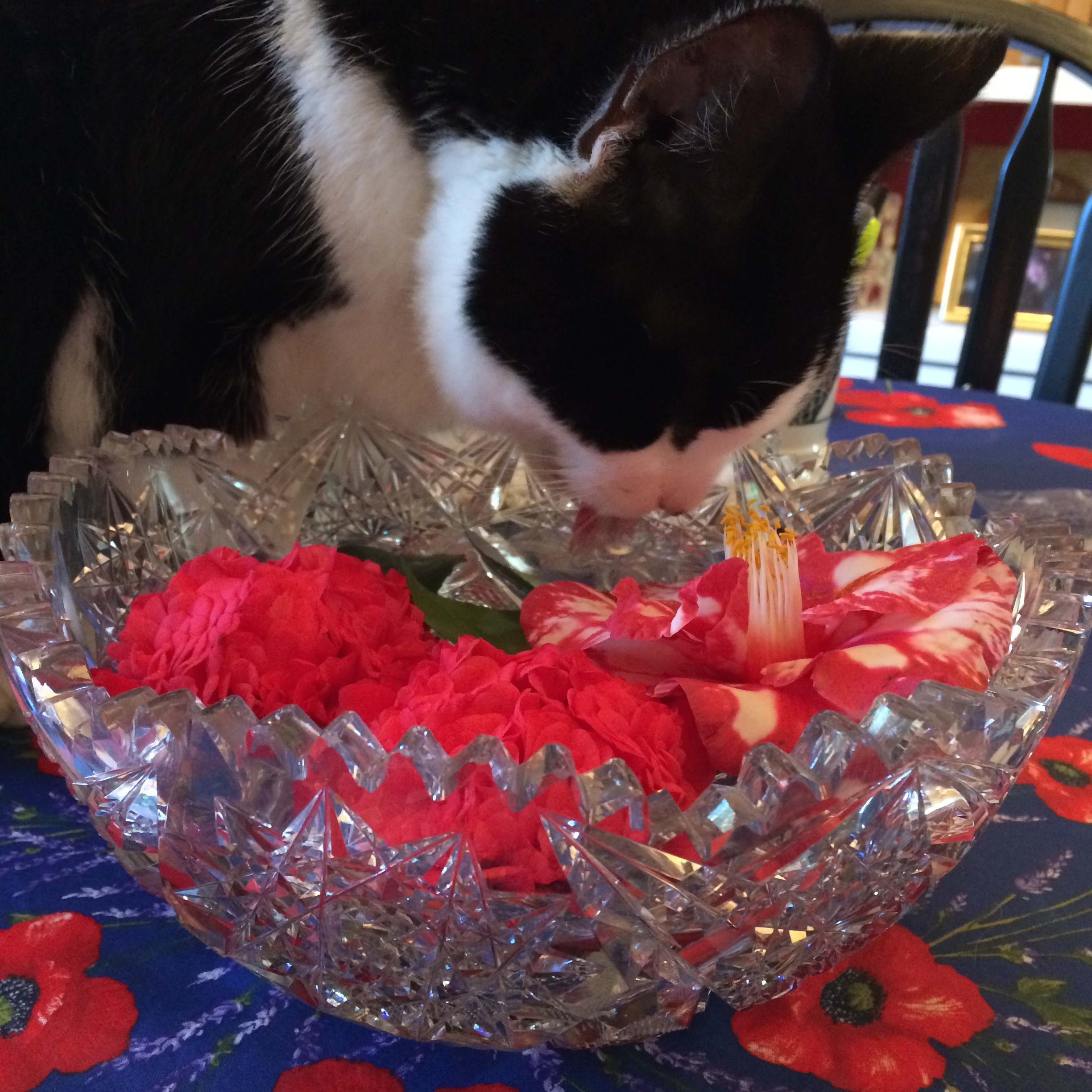
It’s camellia time in the Low country!

photo by lisa z lindahl photo by Lisa Z Lindahl


Even the cat enjoys the camellias…

photo by Lisa Z Lindahl


I still bring other flowers into the house.  A habitual indulgence:

Photo by Lisa Z Lindahl


Hmm…Fire and Air…any wonder they imitate one another?

IMG_8458 IMG_8712


And now my other cat reminds me it’s time to read the important part of the Sunday paper…

IMG_8797


Have a lovely day!

The Question of Taste …

To walk the Way of Beauty and practice True Beauty aspires to transcend our culture’s ingrained notions of “taste.”

Taste, as used here is defined in the dictionary as:

  • the sense of what is fitting, harmonious or beautiful; the perception and enjoyment of what constitutes excellence in the fine arts, literature, fashion, etc.;
  • the sense of what is seemly, polite, tactful, etc., to say or do in a given social situation
  • one’s personal attitude or reaction toward an aesthetic phenomenon or social situation, regarded as either good or bad
  • the ideas of aesthetic excellence or of aesthetically valid forms prevailing in a culture or personal to an individual

It is this last definition that concerns me, that I think of as the crippling aspect within the concept and the notion of ‘taste.’  It is this approach that I believe needs to be unlearned in order to disable our short-cut thinking and become more easily aware of True Beauty.

Think  of what you have found beautiful, and perhaps sought to elevate, honor, call attention to – “Wow! That’s so…uplifting/breathtaking/ beautiful!”…  fill in your word for the experience, for we have all experienced such a moment.   Whether the “that” in question is a particular sight, color, sound, touch, flavor, fragrance, insight, understanding, experience or combination of some or all of the above…. it doesn’t so much matter.

Whole books have been written defending, attacking and/or defining the notion of “taste” in aesthetics. Immanuel Kant, in his “Critique of Judgment” (1928) did a fine job elucidating the subjective and universal nuances in the judgment of aesthetics. David Hume went so far as to create standards for taste, and “wrote the book,” literally.   Taste, frankly,  shouldn’t be much more than a hiccup in the cosmology of True Beauty. Beauty in our new operating paradigm here is not concerned with ideas of rigid standards of “taste” except in so far as it becomes a stumbling block or a barrier for those attempting to practice True Beauty.  Hence, we must attempt some unlearning.

At some points along the way this has been difficult for me.  Because believe me, I was brought up with a healthy dose of  one must have Taste  with a Capital “T.”

This concept of taste is worthy to bring to the discussion because it is an eminent example of the kind of breach that can separate us from (true) Beauty. Separation occurs when there is the Observer and the Observed, the Maker and the Object as Other. When the idea of “taste” goes beyond simple discernment for personal choice and becomes an ethos that defines a group — indeed labels one as belonging to a certain class or level of education — then it is a very effective tool of separation.

True Beauty connects, unifies — it does not create separation.

David Hume was writing in the 1700s.  There is much worthy observation and philosophy in his treatise.  But his exploration into and need to develop standards for taste instructs me in the degree to which our understanding of Beauty had become departmentalized, rationalized by then.  And, eventually,  trivialized.

Why? I think it is because Hume’s stance, in essence, is that one’s level of  taste is based on class, education, and experience; that without these one is most likely to be vulgar and – the worst – common. That through educated experience one learns judgment and discernment.   There is truth in this; it reflects the evolution of understanding.   In my ethos, however,  this would be just fine if the discourse and its implications were strictly limited to the individual and the individual’s own choices, and not broadcast as a levels of societal worthiness, acceptability and – Beauty.

I take exception to shortcuts of perception, recipes – “standards of taste” that have in practice become “coda of beauty.” While I can appreciate the probable intention behind Hume’s book, the resultant elitism and narrowing of aesthetics have had consequences that have proved to be at least equally counterproductive.

The concept of Taste as a Definitor is the child of a civilization that has become so dependent upon appearance, the surfaces of perception and comparative values, with little to no regard for intrinsic and/or deeper values so it can no longer rely on the honest and intuitive senses of its individuals.

Further, such “standards” can be a code to create and preserve a static and deadened place-holder, so there is mere repetition of “beauty” based on a long-ago Hellenic discovery — a sad, time-worn  standard.  The freshness of beauty no longer exists.

Suffice to say for our purposes, Taste as an arbiter of Beauty does not need to enter further into a discussion of True Beauty. If my reader disagrees, I would love to hear from you.

Well, Lou has just come in and has been reading over my shoulder again. “Jeesh!” he says, “What I photo by Lisa Z Lindahlwant to taste is my lunch!  You still sitting here hitting those keys?! Come eat something with me!”

I laugh and tell Lou I will, I will.  And I silently bless my own good taste that brought his bright light into my life.

Beauty is not in the face; beauty is a light in the heart
~ Kahlil Gibran

A Fantasy

Farmers

Teachers

Mothers

What if these were the most revered, the most respected and highly compensated jobs and roles in our society?

What/who are they now?

Football players

Actors

Corporate CEOs

In the interests of being totally transparent, I did little* research about the above other than reading the news and observing what we do for entertainment.  And

I saw a bumpersticker the other day that read:  No Farms, No Food

and that got me thinking…uh… “Right!”, duh!  So:

Nourish the body — farmers

Nourish the mind — teachers

Create & nourish the human — mothers

Imagine with the above scenario of revered citizens:  the Mother who grows citrus trees that repeatedly  bear luscious and bountiful fruit and who then teaches her successful methods to all who are interested to learn.   Year after year…      Songs are written and sung about her.  She is a heroine.

No one has heard of football.  C, E, and O are just letters in an alphabet.  And most everyone has fun being the actors in a play when not watching one!  Then they go back to teaching, or studying to be a better farmer or mother.

~ ~ ~

Oh, I know it is a very simplistic fantasy!  Let me have it for a few moments.

*the research I did do revealed that in actuality doctors, specifically anesthesiologists, are the highest paid occupation in the U.S.  But this was calculated using hourly wage-earning.  I couldn’t find any data on how much Leonard DiCaprio is paid by the hour.  And it would really take a lot of sting and humor out of my essay if I were to mess it up with an actuarial truth.


Raison D’Etre of the Universe?!

True Beauty is the Raison D’Etre of The Universe? 

I am not alone in my suspicion that Beauty is the raison d’etre of our Universe:

True Beauty is both the cause and effect of harmony, of empathy, of community. Beauty unites all things and is the source of all things. It is the great creating cause which bestirs the world and holds all things in existence by the longing inside them to have harmony, Beauty.

I find so much evidence in the literature of quantum physics, general sciences, philosophy, folk wisdoms and mythologies that points to the elemental and essential nature of Beauty’s role in our Universe.

IMG_0062

For instance, from the Science and Math camp – via a theologian, no less — comes this little tidbit: “’Symmetry’ is one of the most frequently recurring words in contemporary scientific literature” (Fr. Diarmuid O’Murchu in Quantum Theology). I would add that “elegance” and “beautiful” would pop up repeatedly on the screen if anyone took the time to do a computerized word scan of current scientific and mathematical lectures and texts. Indeed, one of Brian Greene’s most popular books is entitled “The Elegant Universe.”  Was it Einstein or another mathemetician who said “if an equation is not beautiful, it cannot be correct.”  And tell me: do the Mandelbrot Set—or any fractals– reveal ugly, jarring, disharmonious patterns? Chaos and nature make Beauty. The quantum potential first makes Beauty. Or, and here’s my question: is it that Beauty births the Implicate?

I also find much anecdotal evidence simply by observing the world and its peoples: Beauty is the essence, and is manifest everywhere. It is the mother, daughter and holy spirit, to mess a bit with Christianity’s Trinity.

To again paraphrase O’Murchu, only the heart can intuit the unmanifest level. Our current science will not prove my hypothesis that the vibration that we call “Beauty” is the source of the Universe. Many religions, on faith, believe in Love. My “faith” tells me that love is an outcome, a reaction to, Beauty.

And so to leap to a new, rather poetic definition, of the verb: Beauty is a dynamic process of becoming in the continuum of the expansion of the Universe, expressed in cyclical waves, rising into harmonic being, falling away and disintegrating into entropy, chaos, discord before resolving again into the orderly harmony of True Beauty, only to spew forth again, the Universe expanding, creating itself. 

Over and over and over again.

After reading process philosopher Alfred North Whitehead, I understand how closely this vision of Beauty tracks with his concept of “prehensions” and their processes. This is evidence, to me, of intuitive, collective knowing of the Is-ness.

For this is how I understand the action of Beauty. This is why it is a universally recognized entity among species, especially in the consciousness of man, and why it is the motivator. It is the essential cycle, the essence of not only survival (maintenance), but birth (creation and expansion), and clearance (death). It is the reason to expand.   The Universe’s raison d’etre. Or, to make a joke: as the memetics might like to have it:  the original, the Main Meme.

original art by Lisa Z. Lindahl
Midnight Serenity


Perfection

There is no such thing as perfection.

Perfection as it is commonly understood is an illusory state of being, a static state that is sought in so many realms, by so many.  The pursuit of perfection in our skills/talents/abilities, appearance; in our jobs, in our relationships, in ourselves and in others — it is what creates disappointment and malcontent.  Striving for that Holy Grail of perfection is debilitating.  Even just harboring the expectation of someday having perfection in an aspect of your life can create an overall emotional malaise.

photo by Lisa Z Lindahl
Christmas cat

My parents created the perfect Christmas experience for their four children.  Or so it seemed to me, the youngest.   Many believe fashion models to have perfect faces and forms.  Men and women look and hope for their perfect mate.  Students strive for that “A,” the sign of a perfect performance.

And at this time of year, the start of a new year, a new cycle, we often look again at that far off shining “Perfect State of…”  whatever.  We resolve to do it…gain it…achieve it…capture it…

What is perfection?  Why do we desire it?

If we were to probe our expectations of perfection — what would we find?  Might that idyllic perfection we aspire to have been born from a seed, emotional or intellectual, planted in our past and a bit embellished by memory?  The (fill in the blank) would be, well, perfect!  The object/event/person would meet all criteria that somehow linger in the murky recesses of our craniums.  We’d be happy!  Hmmm.   Please, don’t get me wrong; I do think — know — that our innate impulse to do well or make something better is a productive one.  But are we able to recognize when something is, ah, complete?  Do we notice, linger in and rejoice in the resultant contentment?  Or are we too critical, searching — often subconsciously– for flaws and denying the possibility of completion, contentment?

I have fought my personal Perfection Demon.  I like to think I’ve made progress.  These days for me the idea of perfection is a different way of expressing what I call “high harmony.”  A bringing together of great synchronicities, producing a harmonious vibration (to put it in that parlance) that creates a new and pleasing event, in the broadest sense of the word.    But harmony is not static.  It is ever wavering, ever changing like the universe itself.  IMG_0061

This time of year I think of that “perfect” Christmas I experienced repeatedly as a child.  I have never been able to recreate it, of course.  At least that’s what I think, though I cannot truly know how the holidays my adult self helped to create were experienced by others.  And how were those long-ago Christmases for my parents, who stayed up all night on Christmas Eve to create the experience this child had?

Here’s the thing — and I’ll bet you know it — I am just reminding you:

Letting go of one’s past while also learning from it is the key to a happy present.  (No seasonal pun intended).   And that is often no easy feat.


LEARN FROM THE PAST even AS YOU LET IT GO  

WISHING YOU A HAPPY, HEALTHY 2016,

                                                         Lisa

Holiday beauty in the Lowcountry

Visions of sugarplums

~flowers

dance in my head

~before my  eyes

during this winter holiday:

photo by Lisa Z. Lindahl
My Christmas Geranium

photo by lisa z lindahl

photo by Lisa Z. Lindahl
Nandina, a Chinese evergreen in the yard


photo by Lisa Z. Lindahl
Camellias

And there are some green spirits and holiday fairies around as well…    

photo by Lisa Z Lindahl
tree fairies at play


photo by Lisa Z Lindahl


photo by Lisa Z Lindahl
An Elemental residing out back


HAPPY WINTER SOLSTICE!

THE LIGHT RETURNS!

again…

photo by Lisa Z. Lindahl

IMG_8051


photo by Lisa Z Lindahl


Photo by Lisa Z Lindahl


photo by Lisa Z. Lindahl


Farewell friend darkness.  As you recede and all around begins to awaken, I cling to my last bits of secret slumber.