Magic, Octopuses & Butterflies

What do butterflies and octopuses have in common?

Magic.  Magical cells & jumping genes.   A natural ability to transform themselves.  Personal alchemy!

photo by Lisa Lindahl Oh, don’t we all know about how caterpillars transform into butterflies.  Yet the science behind it cannot obscure the magic of it.  The actual cells responsible for the transformation of fuzzy creepy-crawly into winged flutterer are called “imaginal.”  Imaginal cells.  What a great name!

So these little biological units we call cells have genetic orders to morph themselves into whatever is needed to complete the butterfly design.  Cast yourself into those inner workings:

“Hey, you!  Yeah, you! Hairy cell!  Now you’re gonna be a wing cell!   Whaddaya mean, how?  Look around in your files — somewhere in there are the directions!  And be sure to coordinate with the other guys that used to be hair cells.  Yeah, alla youse!  Flatten out and fly straight, haha!  Be sure to get your color specifics!  Some of you are black, some might be orange.  Have fun with it!”

Magic.  Science.  Genetic code.  All words for the same miraculous phenomenon.
And now octopuses!  With even neural cells that can rapidly change to whatever the whole organism is needing!  Read this excerpt from The Nature Journal:

According to researchers from the University of Chicago, the octopus genome is enriched in transposons, commonly referred to as “jumping genes,” which can rearrange themselves on the genome. Even though their role in octopuses is unclear, researchers found elevated transposon expression in neural tissues. Transposons are known to have the ability to affect the regulation of gene expression and are believed to play major roles in shaping genome structure. (Source)

The headlines for such reports and articles are things like:  “Octopuses Have Alien Genes” and such.  Because, I guess, nowhere else are these jumping genes found.

Further (emphasis mine):

… the octopus genome turned out to be almost as large as a human’s and to contain a greater number of protein-coding genes — some 33,000, compared with fewer than 25,000 in Homo sapiens.

This excess results mostly from the expansion of a few specific gene families… One of the most remarkable gene groups is the protocadherins, which regulate the development of neurons and the short-range interactions between them. The octopus has 168 of these genes — more than twice as many as mammals. This resonates with the creature’s unusually large brain and the organ’s even-stranger anatomy. Of the octopus’s half a billion neurons — six times the number in a mouse — two-thirds spill out from its head through its arms, without the involvement of long-range fibres such as those in vertebrate spinal cords. The independent computing power of the arms, which can execute cognitive tasks even when dismembered, have made octopuses an object of study for neurobiologists … and for roboticists who are collaborating on the development of soft, flexible robots. (from www.nature.com)
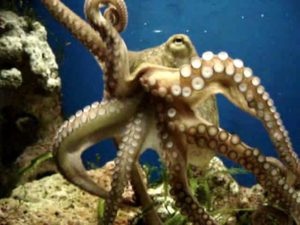
Okay, a lot of verbiage, but I mean, really!  How amazing is that!  Is all of this!  I don’t think I will ever eat calamari again!  (These genes are found in squid and cuttlefish as well).

I’ve always liked butterflies.  Now I think I’m falling in love with octopuses (not, octopi, I’ve been corrected!)photo by Lisa Z Lindahl

PS  Related reading:  The Butterfly Story by Norie Huddle

Art

Often — and unconsciously I think — art and beauty are somewhat confused.

I make art.  My artwork is not True Beauty.  It is just an expression of my creative impulse of the moment.  Sometimes I find my work visually pleasing.  Sometimes I do not, but I have fun creating it nonetheless.

Just sayin’  …


original art Eugenie Z Lindahl IMG_7494_2 IMG_0844

ART007 cropped-VerticalEye2.jpg

An Experience of The One-ness?

photo by Lisa Z. Lindahl

There is no time, nor space.  These are our illusions to help keep a sense of order.

That’s what science is telling us this week.  (I say “this week” because who knows what will be touted as The Truth next week, month, year….  Remember when the earth was flat, and was the center of the Universe?) Anyway, I try to imagine the chaos I would perceive if left without those ordering concepts of space and time.  It is a fun game…

…the tree is over there, and I am here.    Noooo…the tree and I occupy the same space — oops!  There is no space!  So what am I left with?  How do I wrap my head around that?

Here’s what saves me:  experience.  When I was a child — I can’t remember what age, but I recall being about eye level with the railing of the balcony — I had an odd and wonderful experience.  The balcony was off my mother’s bedroom, on the second story of our house.   I was standing there in clear morning sunshine looking into the branches and green leaves of trees.  A slight breeze riffed through the leaves;  a bird’s vibrant call rang out — and all at once I was one with it all.  In every way.  There are no words, really, to describe what occurred.  I have never forgotten the experience.  Interestingly what ended it was my noticing what was happening.

Throughout my life I have come across other experiences and terms to describe them:  “out of body”, “trance”, “journeying” (in the Shamanic tradition), but none — neither experience or terminology — have adequately caught what I experienced that long-ago morning.  Subsequently, still while quite young, I had two other similar experiences but not as complete and intense as that first one, as all too soon I would notice it was happening and that would slip “me” back into regular/normal perception.

Sunlight through California Trees, photo by Lisa Lindahl
Sunlight through California trees

Natural Beauty

Beautiful Hawaiian Sunrise - photo by Lisa Lindahl
Hawaiian Sunrise


The natural world is often a human being’s first introduction to and relationship with external beauty – the True Beauty without.  In our current urban-central, agri-business world, unfortunately too many people develop only a “nodding basis” with the natural world.  Sadly, it is no longer a central reference point for the culture.

Yet our instinctual need for relationship with the natural world and its beauty will out…we create gardens.  We plant pots.  “Gardening” has become a giant industry.  Last I looked it was ranked the #2 hobby of American households.  And everywhere I have traveled around the globe I’ve noticed the ubiquitous window boxes, flower pots, community plots.  

True Beauty is all around us.  The first, basic Practice of Beauty is to actually see.  To practice turning off what I call our sensory “auto-pilot” and really see/perceive what is around us.  We take short-cuts.  That intersection we pass by everyday — when was the last time you really looked at it?  Or the tree in the front yard?

Try it!  How many colors of green do you see outside?  Any pink in that grass?  And purple in that tarmac?  Practice seeing.  You’ll find the habit eventually goes far beyond the merely visual.

Natural beauty is True Beauty.  Eternal.  We yearn for it, and create it as we able.


Garden as an expression of Beauty - photo by Lisa Lindah


A Manifesto for True Beauty

 A Few Bold Philosophical Statements

All contemporary crises can be reduced to a crisis about the nature of beauty.

                                                                                                           ~ John O’Donohue


Polarizing dualities can’t exist and luscious diversity may  unashamedly bloom in a Universe where True Beauty is a  primary paradigm and one of humankind’s guiding references.

This is true for me.

The ancient Greeks revered Beauty.  “The teleology of the Universe is directed to the production of Beauty” declares the father of process philosophy,  Alfred North Whitehead.  “Beauty prompts action” says author James Hillman; “Beauty must replicate itself” states Harvard’s Professor of Aesthetics and author,  Elaine Scarry.

“So what?” my friend and Chief Executive Skeptic, Lou, argues.  “How is beauty relevant at all in a world burdened with wars, starvation and an-increasing gap between the uber wealthy and the rest of us – not to mention the truly poor?”  This is said to me with a look that is a masterful mix of disdain and immediate dismissal; nothing more to be said or thought on the subject.  For Lou, like many others,  beauty is trivial, non-essential and its pursuit is a shallow endeavor.  I say otherwise.  I say we are out of touch with True Beauty.

Yes, in our modern times Beauty has become caricatured, trivialized and marginalized to an extreme and ridiculous point.  It is confused with appearances, relegated primarily to the visual.   Meanwhile the mass media elevates and enshrines bad news, violence, and coarseness.  Elegance, graciousness are derided as hallmarks of the “elite” (odd, since neither of these need to cost anything!), while mediocrity and baseness are somehow socially desireable.

Throughout our recent cultural past, the lowest common denominator has become the highest thing to aspire to.  Or, as one beauty philosopher put it, “It has become the habit of our times to mistake glamour for beauty.”  (O’Donohue).

From Cosmetology to Cosmology

True Beauty (capital “B”)  is a paradox that is far more complex – and simple – than (dare I say?) meets the eye.   Most significantly, healing our relationship to Beauty will in turn heal much of the pathology that our culture is currently suffering.  When  talking about this Beauty we are talking cosmology, not cosmetology. 

Cosmology, from the Greek, originally meant “to order the universe.”  The term has evolved and broadened to reference the order and deep inner workings, relationships and patterns of almost any system.   I  attended a conference on “The Cosmology of Health,” for instance, that had speakers from every aspect of the health field.  So when we address the cosmology of Beauty, we are observing   all its aspects, influences and relationships.  The patterns of True Beauty are everywhere, once we start noticing.  Our deeply industrialized human community  has come to trivialize and obscure this all-pervasive aesthetic force .

The Way of Beauty is this: To  consciously practice the pursuit and cultivation of Beauty beyond surfaces and appearances, to recognize and honor its presence as well as actively engage in Beauty’s creation, preservation and return in prominence in our global culture.  Indeed, practicing Beauty as presented here is to be in synchronicity with the healing of our planet and the physical and spiritual evolution of our universe and its inhabitants.  To this end I have outlined practices (an overused term these days in certain circles), things one can do to be in and of True Beauty.

“Again, why?  Why is be-yoo-tee the big thing?  Wouldn’t it make more sense to help out the planet if we  just stop making wars?”  Lou has re-entered my space and in his usual impatient way, gotten to his version of the nitty-gritty.  He exaggerates the word “beauty” and is making silly faces at me.  I stick my tongue out at him, playfully, and ask him how he proposes to stop all the wars that seem to spring up like toxic mushrooms all over the globe.  He has no answer, and admits to his hyperbole.

I respond, “I don’t know either, Lou,  that restoring True Beauty to a more prominent place in human consciousness will quell our propensity to go to war. But I do know that understanding True Beauty will help at least!  Anyway, be patient, please.  See what you think when I’ve made the rest of my case.”  He snorts and leaves the room;  I turn back to my keyboard.

Timeliness is a factor here.  The concept of Beauty’s essential centrality and importance is not new.  Previous civilizations’ coda have revolved around Beauty.  It needs, however to be remembered and reinstated into our cultural mores, now.  For what is new is the current urgency for this reinstatement.  Although the core and universal nature of aesthetics has been promulgated in the past, NOW it is critical to bring Beauty forward again, into global consciousness, as an integral guiding principal with its power to unite and heal.  We have only to look around our crumbling institutions and old patterns to see that this is so.

” …from the soul viewpoint beauty is a necessary part of ordinary life.”  ~Thomas Moore

Cosmology not Cosmetology

B E A U T Y

C O S M O L O G Y

not

Cosmetology


In our culture today aesthetics are trivialized. Glamour has replaced true beauty. We revere the illusory and, too often, ignore that which is truly beautiful. Think Hollywood vs. the Atlantic ocean; television vs. sunset. What do we pay more attention to?

I am not immune, not “above it all”. Not at all. Television is often my drug of choice. But in a proverbial “dark night of the soul” — mine — I asked myself, what really matters in this life? My answer: true, eternal Beauty. Not those things that are a matter of trend, taste, or style. But eternal Beauty.

And that is what this blog is about: the exploration of the aesthetic, and how it effects our lives.

Well, and on occasion other not clearly related observations.  I do tend to go off on tangents sometimes…

 Cosmology is the order of things…

DSCN1426

.

.

.

While   Cosmetology is about  cosmetics,  appearances,

creating an illusion, perhaps

Zobian Family Photos 038

.

.

True Beauty is eternal.

It is the compass that directs one to harmony.

boys on beach