A Credo of True Beauty

photo by Lisa Z. LindahlDiarmuid O’Murchu, a fascinating Irish scholar and social psychologist,  puts forth one of the best descriptions/explanations of Bohmian of dialogue* in his excellent book, “Quantum Theology.”

I had always thought of this process (though I had no name for it) more as a way of being, really. When I thought consciously along these lines, it was in terms of “nonattachment,” or “objectivity.”

In my best moments, I strive to live life as a “dialogue.” I.e., unattached to any one point of view, deeply listening, open to all points of view without having to “have it” or “take it on” on a personal level, and being response-able — able to respond — hopefully with the greatest good in mind. At the same time to be aware of my own preferences and choices, and also responsible for my own condition in so far as I am consciously able (which one works at to continue to become more conscious). And always aware of beauty, supporting it, nurturing it, being surrounded in it.

This is the closest to a personal “credo” I have articulated in recent times. Deepak Chopra has said, “Quantum physics are the mechanics of creativity; reincarnation is the quantum leap of creativity…the soul takes on new expression.”[1] Until recently I considered Deepak’s comment to refer only to the life/death cycle. Today, I see its application to my own credo and attendant learning spirals: quantum leaps of understanding that leave me dying in one reality while popping into another – one that sometimes defies wordy articulation but can be summed up in a sweeping gaze while at the beach.

And, I have come to understand that I am endeavoring to practice beauty.


The dialogue between theology and science is not a dialogue at all;
it is a drama of the human spirit.   ~Alexei Nesteruk


* Wikipedia definition:  [Bohmian] dialogue has no predefined purpose, no agenda, other than that of inquiring into the movement of thought, and exploring the process of “thinking together” collectively. … allow group participants to examine their preconceptions and prejudices, …explore the more general movement of thought. … Dialogue should not be confused with discussion or debate, both of which, says Bohm, suggest working towards a goal or reaching a decision, rather than simply exploring and learning…
[1] Excerpted from a lecture in workshop, “Seduction of Silence,” April, 2005, Lake Lanier, GA

Tomato Grace

photo by Lisa Z Lindahl

From a near-by correspondent:

    This week I have my first ripe heirloom tomato. In march, the unlikely plants emerged from a weed filled box in my greenhouse. They must have grown from seeds I saved last season and in an obviously foolhardy act, like someone buying a lottery ticket, I cast them into the dirt. I may as well have planted redwoods. I knew better. All those years of pouring hope and fertilizer onto Lowe’s bought plants with visions of that perfect mid summer BLT, only to experience another failed harvest. Growing tomatoes in South Carolina is a valuable primer on life.
     But for the grace of mother nature and that leak in my ceiling, I am rewarded with one meager tomato and one great lesson.  This is a thing of wonder and beauty.

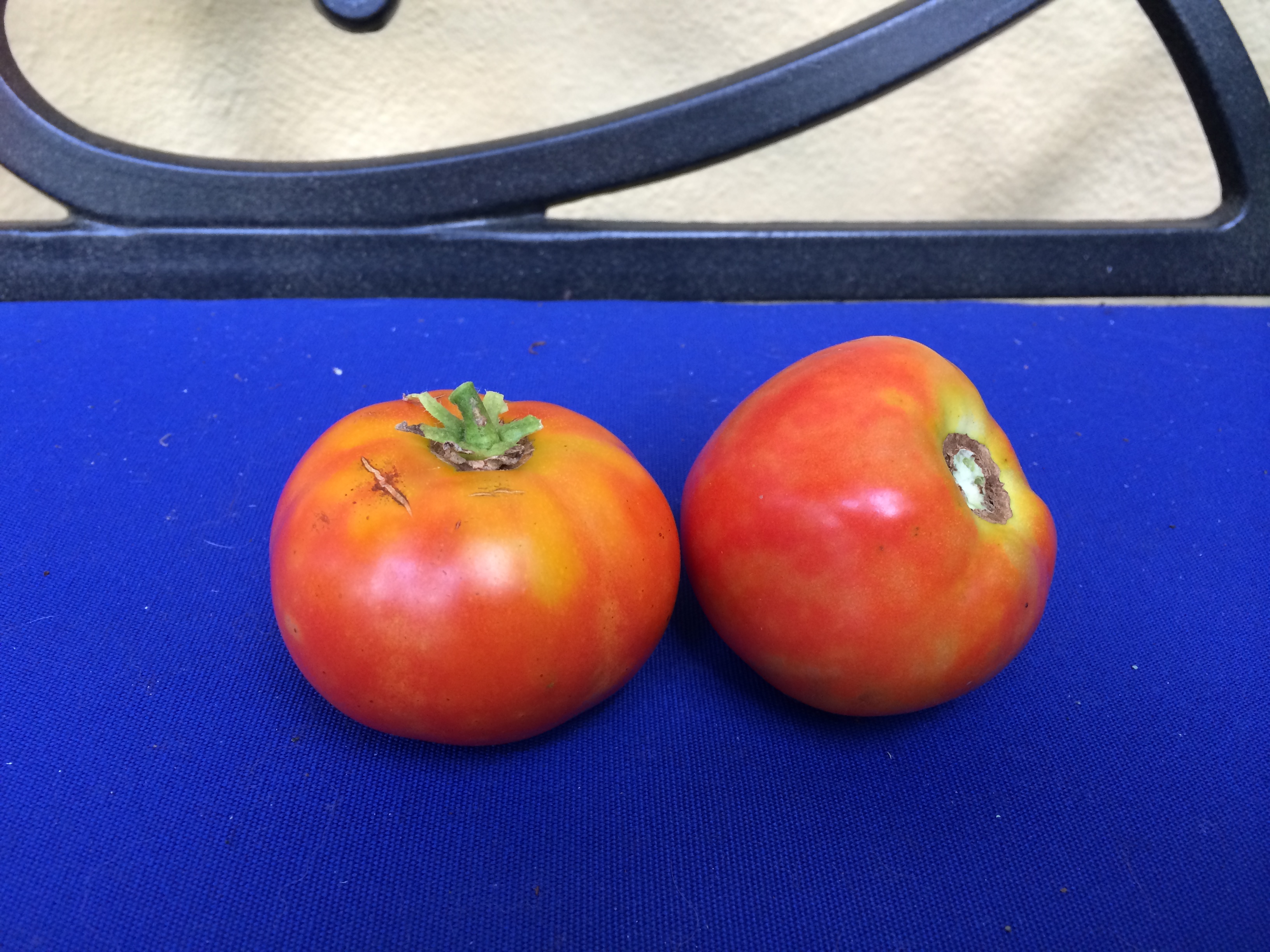
photo by Lisa Z LindahlAh.  Fabulous!


I must rush to say, however, that the accompanying photo here is not my correspondent’s excellent and rare single heirloom.  No, these two are simple market-boughts from last summer.  But beautiful enough to have caught my camera’s eye.  A bit more, uh,  Tomato Grace?


The Question of Taste …

To walk the Way of Beauty and practice True Beauty aspires to transcend our culture’s ingrained notions of “taste.”

Taste, as used here is defined in the dictionary as:

  • the sense of what is fitting, harmonious or beautiful; the perception and enjoyment of what constitutes excellence in the fine arts, literature, fashion, etc.;
  • the sense of what is seemly, polite, tactful, etc., to say or do in a given social situation
  • one’s personal attitude or reaction toward an aesthetic phenomenon or social situation, regarded as either good or bad
  • the ideas of aesthetic excellence or of aesthetically valid forms prevailing in a culture or personal to an individual

It is this last definition that concerns me, that I think of as the crippling aspect within the concept and the notion of ‘taste.’  It is this approach that I believe needs to be unlearned in order to disable our short-cut thinking and become more easily aware of True Beauty.

Think  of what you have found beautiful, and perhaps sought to elevate, honor, call attention to – “Wow! That’s so…uplifting/breathtaking/ beautiful!”…  fill in your word for the experience, for we have all experienced such a moment.   Whether the “that” in question is a particular sight, color, sound, touch, flavor, fragrance, insight, understanding, experience or combination of some or all of the above…. it doesn’t so much matter.

Whole books have been written defending, attacking and/or defining the notion of “taste” in aesthetics. Immanuel Kant, in his “Critique of Judgment” (1928) did a fine job elucidating the subjective and universal nuances in the judgment of aesthetics. David Hume went so far as to create standards for taste, and “wrote the book,” literally.   Taste, frankly,  shouldn’t be much more than a hiccup in the cosmology of True Beauty. Beauty in our new operating paradigm here is not concerned with ideas of rigid standards of “taste” except in so far as it becomes a stumbling block or a barrier for those attempting to practice True Beauty.  Hence, we must attempt some unlearning.

At some points along the way this has been difficult for me.  Because believe me, I was brought up with a healthy dose of  one must have Taste  with a Capital “T.”

This concept of taste is worthy to bring to the discussion because it is an eminent example of the kind of breach that can separate us from (true) Beauty. Separation occurs when there is the Observer and the Observed, the Maker and the Object as Other. When the idea of “taste” goes beyond simple discernment for personal choice and becomes an ethos that defines a group — indeed labels one as belonging to a certain class or level of education — then it is a very effective tool of separation.

True Beauty connects, unifies — it does not create separation.

David Hume was writing in the 1700s.  There is much worthy observation and philosophy in his treatise.  But his exploration into and need to develop standards for taste instructs me in the degree to which our understanding of Beauty had become departmentalized, rationalized by then.  And, eventually,  trivialized.

Why? I think it is because Hume’s stance, in essence, is that one’s level of  taste is based on class, education, and experience; that without these one is most likely to be vulgar and – the worst – common. That through educated experience one learns judgment and discernment.   There is truth in this; it reflects the evolution of understanding.   In my ethos, however,  this would be just fine if the discourse and its implications were strictly limited to the individual and the individual’s own choices, and not broadcast as a levels of societal worthiness, acceptability and – Beauty.

I take exception to shortcuts of perception, recipes – “standards of taste” that have in practice become “coda of beauty.” While I can appreciate the probable intention behind Hume’s book, the resultant elitism and narrowing of aesthetics have had consequences that have proved to be at least equally counterproductive.

The concept of Taste as a Definitor is the child of a civilization that has become so dependent upon appearance, the surfaces of perception and comparative values, with little to no regard for intrinsic and/or deeper values so it can no longer rely on the honest and intuitive senses of its individuals.

Further, such “standards” can be a code to create and preserve a static and deadened place-holder, so there is mere repetition of “beauty” based on a long-ago Hellenic discovery — a sad, time-worn  standard.  The freshness of beauty no longer exists.

Suffice to say for our purposes, Taste as an arbiter of Beauty does not need to enter further into a discussion of True Beauty. If my reader disagrees, I would love to hear from you.

Well, Lou has just come in and has been reading over my shoulder again. “Jeesh!” he says, “What I photo by Lisa Z Lindahlwant to taste is my lunch!  You still sitting here hitting those keys?! Come eat something with me!”

I laugh and tell Lou I will, I will.  And I silently bless my own good taste that brought his bright light into my life.

Beauty is not in the face; beauty is a light in the heart
~ Kahlil Gibran

A Reminder

photo by Lisa Lindahl
Southern winter sky

In this season of love and giving I thought it fruitful to remind my readers — and myself — of the essence of what this blog is about.

The nature of True Beauty (to make the distinction from the the sort sought at cosmetics counters),  is its importance in our everyday lives.   How to bring deep, true Beauty into our daily routines and recognize what True Beauty already exists in our life – this is at the heart of The Way of Beauty and its Practices.

The awareness, contemplation, cultivation and intention of True Beauty enhances and engenders harmony in all dimensions. To “as above, so below” I would add “as within, so without; as without, so within.” Think perceptions, attitudes, relationships here.  And take a look around your house.

The new reports illustrate why the reclaiming of the actual nature and importance of True Beauty in our lives NOW is so important.

The perception and recognition of this kind of Beauty is available to virtually everyone.  As Helen Keller famously noted,

“The best and most beautiful things in the world cannot be seen or even touched—they must be felt with the heart.”

And while I spend time looking at some definitions of “True” Beauty and what its parameters might be, it is vital to note that the variety of Beauty we concern ourselves with here — “deep” or “true” beauty —   goes far beyond  what only our senses may measure, what treasures money will buy; far beyond the appearance of things, notably the human face and form.

Noticing and embracing this “meta-beauty” in our lives is a step towards our own strengthening and, I propose, the healing of much of the existing cultural pathology that has arisen during the paoriginal art by Lisa Z Lindahlst century — a century that has been the era of True Beauty’s demise.

The Way of Beauty aspires to transcend notions of standard “taste” as well as evaluations of what each of us finds beautiful, and rather, seeks to elevate, honor, call attention to the importance of that moment of
engagement – “Wow! That is so beautiful” — that we have all experienced. Whether the “that” in question is a particular sight, color, sound, touch, taste, fragrance, insight, understanding, experience or combination of some or all of the above…. it doesn’t much matter.

So try thinking with this notion of True Beauty during this holiday season.  You might give serenity; receive laughter.

With love,

Lisa


Holidays, Holy Days, Holi-Daze

I’ve never liked November.  I don’t exactly know why, especially since there are so many celebrations in my family in November as well as, of course, Thanksgiving.  And I’ve always enjoyed Thanksgiving, so why do I dread November?photo by Lisa Z Lindahl

Perhaps it is the dreary weather so often encountered in the Northeast, where I grew up and lived for so many years.  Lack of sun, the gray and too-barren landscape, early snow storms conspire to undermine my personal practice of Beauty.  I can find that Beauty in November’s landscape — but I have to work harder at it, and that bothers me.

photo by Lisa Z Lindahl
Camillia sasanqua

It is easier here in the Southeast.  The camellias are blooming red, pink and white in my yard.  The Live Oaks wear their stoles of Spanish Moss which sways elegantly in the November breezes.  There is plenty of sunlight.  I need only to look out to encounter True Beauty in this place’s November.

Spanish moss hanging from Live Oak in the evening
Spanish moss hanging from a Live Oak in the southern evening


My November discomfort may be related to the holidays — or what I call the holi-daze.  Over the course of my life I have spent too many of them alone, and that has been difficult.  When I recall all the past holidays that were filled with family and loved ones I too often compare and contrast with the “alone” holiday experiences.

But as I have written elsewhere, comparing and contrasting can be an unproductive trap.  The action may eviscerate any truth of the Beauty at hand, here in the present.

And here I am, looking at my dread, figuring it out, moving away from it and beyond — I hope!  And remembering that I am so grateful to be living in this country, in these times, where we have so much freedom to be.  To be.

So:

HAPPY DAY, HAPPY THANKSGIVING — GIVE THANKS! 

A Practice or a Habit?

photo by Lisa LindahlSo here I have been outlining how to engage in the Practice of True Beauty.  And why.  But have you ever wondered what the differences are between a “practice” and a “habit”?

A habit is a routine.  While it may have begun with intention, it no longer needs thought behind it — it is part of one’s Automatic Pilot dashboard.  It achieves some task:  teeth get brushed.

A practice is just that – practice.  It implies “rehearsal” for something more real?, permanent?, or better done that will occur at another time/place/space.  A practice also implies it has been taken on with an intention attached to it.  Part of that intention is to improve over time.  I don’t think of my habits as necessarily having an element of improving.

A Caution about Practices

However, engaging in a practice may sometimes get in one’s way.  In his book  The Exquisite Risk, Daring to Live an Authentic Life, poet and philosopher Mark Nepo puts it well:

All the practice in the world can’t instigate enlightenment or revelation. It can only make us ready vessels for when these moments occur. … practice implies practice for something, usually a readying of the self…for the unexpected moment of life…

“vessels for…the unexpected moment of life…”   Why do we practice meditation?  Why do we introduce the practice of going to the gym each day?  We must not forget the purpose behind the practice.

“Like Uncle Sam!” Lou says.  “Remember all those times we had to eat cold Thanksgiving dinner because of waiting for him?  He was always having to get his run in after he meditated for an hour, and meanwhile the whole family had to wait for him before sitting down — and Aunt Grace seemed always to time the turkey to be ready just as he went out the door, remember?  When I was little it confused me like mad!  When I got older I was really annoyed.  Hungry!  I mean really — one day outta the year you can’t change your schedule dude?”

I commiserated with Lou, having privately thought the same thing, and wondering why his sweet wife hadn’t thought to time her meal differently — or let us go ahead without him.  Sam’s rigid meditation-cum-run devotion had not seemed to deepen his well of compassion or cooperation.  Ah, well.  Things change.  We’ve moved away and now have our own hot Thanksgiving dinner, sans Sam and Grace.  Still, I miss them, actually.

Lou is still thinking out loud about habits and practices…

“But habits — hey, we have to do something when we close down the screen, right? Before your Big Mr. Universe comes knocking at our door, beckoning us out into the cosmos! I can just see Mr. Universe! Big Hairy – oh, oh! Okay, MS. Universe. Hairy Ms. Uni — Oh! Oh! OKAY. The Universe has no gender? What?”

By this time I am hitting Lou over the head with a pillow from my chair. He squeals and runs out laughing and yelling something about pacificism and beauty and practicing what I preach.

But Lou, as usual, has a point. With the TV, computer, phone off and our automatic pilot off — that Captain of Habitual Activity — we might as well choose to intentionally practice something.  So let’s practice True Beauty. It really does include a great deal of variety: Being funny, being quiet, walking or swimming or some such, any kind of art or production, looking at everything, hanging out with friends, giving and getting some loving – not too difficult, eminently satisfactory.

For once, Lou might agree with me.

Meanwhile though, make sure that in the name of your “practice”, you are not avoiding life.  Life, with all its glory, it’s messiness, and oh yes — it’s unexpected sprouts and spouts.

photo by Lisa z Lindahl


Disassociating from Beauty

Losing touch…

How is it that we get separated from our engagement with True Beauty? How does it happen and what replaces it?

DSCN2636One example might be as simple as our eating mode. These days we are so separated from our food sources that children think chickens come from plastic boxes or buckets and spinach from a cellophane bag. What a shocking experience for a city kid to cut a wad of spinach from a plant or pull a carrot out of the earth, with dirt hanging from its orange self – and call each fresh and healthy! A quick wash and ready to eat! What is dirt? What is dirt-y? What is all that cement and blacktop? What is it covering up? What is ugly? What is beautiful? What is potential?  Who cares and why?

The role of Natural Beauty

The natural world is often a human being’s first introduction to and relationship with external beauty – beauty without. And in our current urban-centric, agri-business culture, most people are on a “nodding basis” only with our natural world. It is something driven by during the commute, a lawn to be mown, the subject of an ETV documentary about an exotic place, a tree in a park.  While gardening is a giant industry, and ranked a top hobby of American households, still too many souls receive and participate in too little of nature’s beauty, let alone pay attention to and participate in the magic of its cycles.

Aside from the obvious simple Beauty that a garden creates, the relationships one forms while creating and tending it – with the soil, the plant, the animals, birds, bees and insects, the weather and cycles – are enriching and enhancing. And sometimes annoying and frustrating. Can I put that bit under “character development?”

Some small but powerful practices that help re-introduce us to the rhythms of Beauty might be: turning off the TV (or getting rid of it), ceasing to get your daily “news” from the fear-mongering mass media, or making dinner for a friend once a week or so.  Sitting quietly each day (preferably outside) also ranks right up there.  The 18 Practices of Beauty review all of these possibilities.

I believe we must help ourselves and others re-learn to consciously connect with the harmonies in our lives.  With True Beauty.  It is all around us, all the time.  Look up.  Feel out.  Enjoy.

photo by Lisa Z. Lindahl


Ageless Wisdom Practices

Supporting Practices for The Way of Beauty

At the risk of sharing “platitudes as insights” as one journalist put it recently, there are three Beauty Practices that are old chestnuts, as my mother used to say.  They have been in the culture for a very long time, and certainly have not been identified as “Beauty Practices,” though indeed they are, as they contribute to True Beauty unfailingly.   These practices, human activities, whatever we choose to name them have endured through many civilizations and cultures because of their beneficial effect on the human body, mind and spirit — and consequently on our planet (not hyperbole).  I have come to understand these as supporting and basic to the other practices of the Way of Beauty.

I bet you know them:

Zobian family photos1)  Practice “The Golden Rule

Do unto others as you would have them do unto you.  Really, such common sense.


photo by Lisa Lindahl2)  Be still

Whether it is meditation, time in prayer or simply sitting quietly in a spot that resonates with you…find time each day to be still.  It is amazing what comes in, or what is resolved, or repaired when serene time/space is made available.


photo by Lisa Lindahl3)  Be active

Whole libraries could be filled with books written about the myriad ways in which an active body is beneficial to mind, body and spirit.  No need to re-iterate here.  I believe that the body is the temple of the soul, and so must be cared for and maintained as such.  Not always a simple task as we age, BTW.

So these are the supportive and basic three.  In “The Way of Beauty” book more is said about how they specifically support and align with True Beauty, creating greater harmony.

And a little reminder — to myself as well — these are practices.   I shall point out, as we sometimes forget:  there is no “end state” of any of these activities, though some yogis might argue with me. These are ways of being.  And as none of us (except me & thee, perhaps) are perfect, they are rarely static or constant.   I fall short a great deal, currently in the keeping my body active department.  But I do practice at it.  I do my best to practice the Golden Rule.  Being still is far easier; noticing beauty does that for me.  Practice, practice, practice.

Oh, and have fun doing so.


Being Happy – A True Beauty Practice!

Practice the Pursuit of Happiness

The happiness that is genuinely satisfying is accompanied by the fullest exercise of our faculties and the fullest realization of the world in which we live.

~Bertrand Russell

Do you see the glass half full or half empty?

“Pursuit of Happiness” – it’s in America’s Declaration of Independence, and it is an integral part of practicing Beauty. Integrating Beauty is about broadening harmony, and creating harmony has a great deal to do with each individual’s ability to understand their own experience of happiness. And that is something that has become increasingly elusive in our modern society.

So, what’s the trick?

IMG_7920 - Version 3See the proverbial glass. See it half full and half empty. See the whole glass. Cultivating happiness, and the ability to have happiness is a choice, or more correctly, a continuum of choices. But at its root, being happy
is being able to see, to observe “the whole glass” and still choose to emphasize its fullness. So we have come, quite beautifully, full circle: back to the ability to see, our first practice —  in order to have happiness, our last primary practice.

In their book How We Choose to Be Happy, Rick Foster and Greg Hicks did an impressive survey of how people achieve and maintain happiness. They were not looking for the “rose-colored glasses” kind of happiness, either.   Their subjects felt all emotions deeply. In fact, it is from the Foster/Hicks survey that the proverbial Glass metaphor is resurrected.

One of the foremost results was the uncovering of this ability by those deemed to have maintained sustainable happiness to see the glass both half full and half empty.  I.e., to see the balance in each situation, pros and cons, good and bad, and then to choose to concentrate on the positive aspects. This, according to the authors, created stable happiness.  The survey revealed that consistently happy people were far from being in denial about the less than optimum, shall we say, aspects of their lives. The paradox being that in order to experience great happiness, we must also be able to experience life’s greatest sorrows.

Hence, do we conclude that the choice to pursue happiness is, perhaps, a strategy that can carry us through all that life has to dish up?

Seeing the glass, the whole glass, is a Beautiful ability. To be aware of the complexities, of the polarities original art (c) E.Z. Lindahlnecessary to create balance bequeaths a sense of harmony to the one observing and experiencing this wholeness. To see only a part is to experience only a fragment. Having only that experience, one tends to be reflecting only a fragment; to be, perhaps, one-side, or fragmented.  Don’t we all know that person who persistently sees only the glass half-empty?  For whom there is always an issue, problem, something not quite right enough?  And then that other person, who refuses ever to see any problem, anywhere; who even as the house falls down around her/him peers through those rose-colored glasses and says “Oh, it will all be fine.  Maybe I’ll think about it tomorrow.”

To see the glass, whatever it holds and how much/little of each, is to begin to allow for the “Both/And Universe.” It allows for all the layers of Truth. It gives space for our authentic self to be still, perhaps take a moment…and choose to see a good, a learning, some positivity in the situation without denying its darkness, from which we may create and/or begin again.

Choose happiness.

To Practice Pursuing (& increasing the catch of) Happiness:

  1. Make sure you are being honest with yourself about yourself.
  2. Take responsibility for your own circumstances: you are in charge of your situation. Attitude!
  3. What feelings, specifically, do you associate with being happy?
  4. Identify those things, people and/or events, both small and big that contribute to your feelings of contentedness.
  5. Surround yourself with “higher companions,” those people who have your best interests at heart. Politely avoid those in “nay-sayer mode” (and we’ve all been there!).
  6. If you fall into a dark place for a bit, recognize it, don’t bury it. Take it out for a walk. Own it and try not to spread it around inappropriately.  Once you’ve had a good cry or rant, look further and see what’s next.  Repeat as necessary.
  7. Always remember: This too shall pass. So cherish the light and respect and endure the darkness.

Happiness is a particularly enhanced, perhaps human, state of harmony. It is an important Beauty practice. Do not think for a moment it is trivial or shallow. Some of the happiest people are the most productive.   photo by L. Lindahl

His Holiness the Dalai Lama has had a great deal to say about happiness:

“The basic thing is that everyone wants happiness, no one wants suffering. And happiness mainly comes from our own attitude, rather than from external factors. If your own mental attitude is correct, even if you remain in a hostile atmosphere, you feel happy. …

When we feel love and kindness toward others, it not only makes others feel loved and cared for, but it helps us also to develop inner happiness and peace. …

Consider the following. We humans are social beings. We come into the world as the result of others’ actions. We survive here in dependence on others. Whether we like it or not, there is hardly a moment of our lives when we do not benefit from others’ activities. For this reason it is hardly surprising that most of our happiness arises in the context of our relationships with others. “

But what is happiness except the simple harmony between a man and the life he leads?

~Albert Camus
“


Bit o’ History — Aestheticism

IMG_0693As I’ve mentioned before, the notion of the importance of Beauty is not new.  The Aestheticism movement of the late 1800s  in Europe and America caused quite a stir.  It posited that beauty was above concepts such as right and wrong.  Aestheticism adherents eventually evolved their own brand of elitist hierarchy, however.  I say “however” since a hierarchy to me implies a sense of righteousness, of superiority — an assumption of right-er vs. lesser, if you will.

Aestheticism was “art-centric.”  Based in the philosopher Emmanuel Kant, following the French “l’art pour l’art,” under the Aestheticism banner the concept of beauty became too synonymous with art.  True Beauty is not confined to or articulated by “art” alone.  Further, in Aestheticism there is an assumption that nature’s own beauty (think composition, colors, material combinations) itself is in need of improvement through man’s orchestration.  I find this arrogant at worst, and at its best simply a developmental phase in humankind.  Or so I might like to think.

One of Aestheticism’s better known spokesmen was Oscar Wilde.  Born in 1854, Wilde lectured often and

Oscar Wilde
Oscar Wilde

vociferously on the importance of art and beauty in people’s everyday lives.  He is quoted as saying “We spend our days looking for the secret of life.  Well, the secret of life is art.”  (Once again inferring that art and beauty are synonymous).  He also said “Even a color-sense is more important in the development of the individual than a sense of right and wrong.”  Hmmm.

This movement emerged in response, in part, to the ugly influences of utilitarianism and the then newly flourishing industrial revolution.  But I see such a prominent paradox.  While proclaiming that all should have beauty/art in their everyday lives, this crowd perceived themselves as superior to the group that would come to be classified as the “working class.”  An artist, a creator of beauty was considered superior.  Yet so many of those who had previously been the “crafters” or makers of furniture, paints, metal work, woodwork, fine art glass, etc. — many of them were now in the factories.  But , oh!, were no longer considered to have enough “taste” to appreciate “The Arts” as conceived by Aestheticism’s aesthetes.  While lauding art for art’s sake, Aestheticism’s adherents did not appear capable of recognizing the ubiquitous eternal nature of Beauty or the diversity of its makers and fans.

Hence, while eschewing the notions of right and wrong in favor of beauty and art on one hand, they were busily creating an elitist group and attitude that shut out entire populations based on their “everyday living” rather than on their sensibilities, talents, or (dare I say?) appreciation of art.

Aestheticism as a movement of the 19th century seems an good example of blinkered arrogance raising its nasty head in relation to the promulgation of the concept of beauty.  It started with a noble intent, yet refused the broader and spiritual component that could provide the far-reaching healing for humankind.  It had the idea correct — Beauty is transcendent — but the execution wrong.  It’s not just about “art,” and certainly not about the sculpting and supposed improvement of the wild.  It is not only about refuting the current cultural trends in morality.  It is not just “l’artiste” who can sense or create beauty.

The sheer universality of Beauty’s truth appears to have been missed by Wilde and his cohorts.  But they may have been on the right track.  Now we must make some corrections and move forward.

There is a principle in organizational development circles, “Just because an idea (or product, or process) didn’t work earlier, doesn’t mean it won’t work now.  Review and re-evaluate.”  Beauty and its transcendent nature is an idea whose time has always been, and now hopefully we are mature enough as beings, able enough and conscious enough to review, re-evaluate and go forward anew — recognizing the inherent importance of True Beauty for all: human, planet, universe.

Out beyond ideas of wrong-doing and right-doing    

There is a field    

I’ll meet you there.

When the soul lies down in that grass  

The world is too full to talk about.        

~Rumi

photo by Lisa Z. Lindahl